

OAN Staff Lillian Mann
6:00 PM – Monday, May 4, 2026
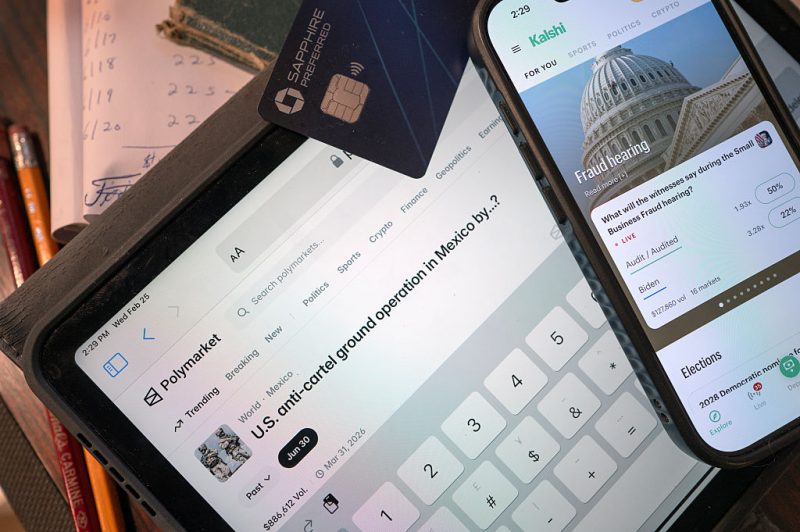
The U.S. Senate voted unanimously on Thursday to prohibit senators, their staff and other chamber personnel from using prediction market apps — marking a decisive step to address growing ethical and national security concerns surrounding such platforms.
Additionally, since the Senate only has the power to change its own rules, the ban currently only applies to Senators and their staff, not the entire U.S. Congress.
Before leaving on a week-long recess, the Senate passed the measure, led by Senator Bernie Moreno (R-Ohio), to immediately ban insider trading within the Senate on trading apps such as Polymarket and Kalshi.
The trading apps allow users to anonymously bet on the outcome of almost anything, ranging from sports, celebrity gossip, and even major political and military outcomes.
Meanwhile, the vote follows Kalshi’s decision in April to ban three political candidates who had attempted to bet on their own races, as well as a U.S. Special Forces officer who won $400,000 after betting the December raid, which captured Venezuelan socialist dictator Nicolás Maduro, would be successful.
The surge in betting has raised growing concerns over ethical and national security matters, as a spike in betting on certain geopolitical outcomes have emerged with the growing popularity of the apps.
Senator Elissa Slotkin (D-Mich.), a former CIA analyst who served in Iraq, called potential cases of insider trading on prediction markets “an operational risk.”
Additionally, Senator Moreno (R-Ohio), who sponsored the ban, emphasized, “Serving in Congress is an honor, not a side hustle, Americans deserve to know that their leaders are here for the right reason.”
“I don’t believe we should trade stocks at all. It’s completely insane,” Moreno said. “I think we should focus on our jobs and have our voters go, ‘Hey, this guy’s voting this way, because this is the right thing for the state.’”
Notably, at least 16 accounts have made more than $100,000 after correctly predicting a February strike on Iran, hours before the U.S. and Israeli attack on Iranian officials killed Iran’s supreme leader, Ayatollah Ali Khamenei.
“We must never allow Congress to turn into a casino where members representing the public can gamble on wars or economic crises or elections,” Chuck Schumer (D-N.Y.) said on the Senate floor on Thursday. “Speaker Johnson should immediately do the same thing in the House,” he added.
Senator John Curtis (R-Utah.) teamed up with Slotkin and Senator Todd Young (R-Ind.) on a bill that would ban government officials and employees—including the president and vice president—from participating in prediction markets. The measure would impose fines equal to twice the profits gained from such bets.
Both Kalshi and Polymarket have issued public statements supporting the Senate’s decision to ban its members from their platforms, signaling a desire to align with federal ethics standards while defending the integrity of their markets.
Despite these assurances, the industry has struggled with high-profile instances of self-dealing that suggest insider trading remains a persistent challenge. In April 2026, Kalshi took the unprecedented step of fining and suspending three congressional candidates for attempting to wager on their own election outcomes.
The sanctioned individuals included Mark Moran, an independent Senate candidate from Virginia; Ezekiel Enriquez, a Republican who ran in a Texas primary; and Matt Klein, a Minnesota state senator seeking a seat in the U.S. House.
In response to the growing scrutiny, Kalshi CEO Tarek Mansour emphasized that the company already “proactively blocks members of Congress” from participating in its markets to maintain data purity. To enforce this, Kalshi spokesperson Elisabeth Diana explained that the platform utilizes a sophisticated “politically exposed persons list” to identify and filter out individuals with a high risk of possessing material, non-public information.
While the companies maintain that their platforms are intended to serve as “truth machines” for forecasting, the Senate’s unanimous vote reflects a broader legislative consensus that the risk of insiders “governing for profit” outweighs the potential benefits of these predictive tools.
Stay informed! Receive breaking news alerts directly to your inbox for free. Subscribe here. https://www.oann.com/alerts
What do YOU think? Click here to jump to the comments!
Join the conversation!
Please share your thoughts about this article below. We value your opinions, and would love to see you add to the discussion!