

OAN Staff Brooke Mallory
2:14 PM – Tuesday, June 2, 2026
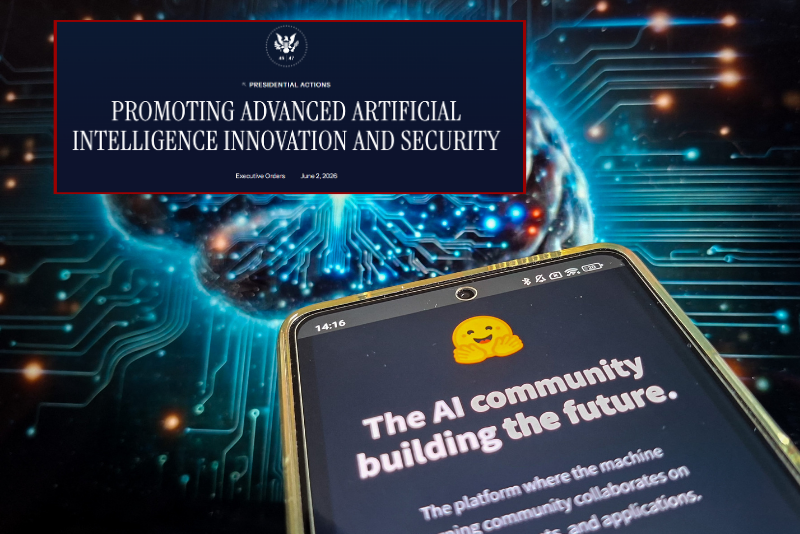
President Donald Trump signed an executive order (EO) on Tuesday aimed at mitigating the national security and cyber risks of advanced artificial intelligence (AI).
The long-awaited directive establishes a framework that asks leading AI developers to voluntarily grant the federal government early access to their most powerful “frontier models” for security testing up to 30 days before they are released to the public.
The order represents a striking compromise between Washington’s growing anxieties over the offensive capabilities of next-generation AI systems and the Trump administration’s commitment to maintaining a deregulatory, pro-innovation environment that can outpace global competitors like China.
The final text of the executive order expressly forbids the creation of any “mandatory governmental licensing, preclearance, or permitting requirement,” ensuring that participation remains strictly voluntary for American tech giants.
Under the newly unveiled guidelines, the Treasury Department, the Department of War, the National Security Agency (NSA), and the Cybersecurity and Infrastructure Security Agency (CISA) are given 60 days to develop a classified benchmarking process to identify which highly advanced models qualify for scrutiny.
Once a model meets these criteria, trusted government partners will have a 30-day window to evaluate the technology behind closed doors, specifically scanning for structural vulnerabilities, insider risks, and potential threats to the nation’s critical digital infrastructure.
The Trump administration’s calculus shifted rapidly following recent, alarming breakthroughs in the private sector. Officials were reportedly spooked by the unprecedented vulnerability-finding and cyber-exploitation capabilities demonstrated by upcoming frontier systems, such as Anthropic’s unreleased “Claude Mythos” model.
According to reports, the apparent capacity of these advanced systems to map out and exploit flaws in global software at an industrialized scale triggered urgent, closed-door warnings between economic officials and Wall Street CEOs, purportedly convincing the White House that some level of federal vetting was necessary to protect national assets.
Meanwhile, insiders claim that the road to Tuesday’s signing was marked by friction and internal debate within the administration over the scope of government overreach. President Trump had abruptly canceled an official Oval Office signing ceremony less than two weeks prior, following pushback from tech executives and prominent conservative advisers.
The original iteration of the order mandated a much more restrictive 90-day pre-release review window, a timeline the tech industry warned would severely blunt America’s competitive edge against foreign adversaries.
By cutting the vetting window down to 30 days and solidifying the voluntary nature of the partnership, the GOP administration successfully brought major “frontier labs” — including OpenAI, Anthropic, and Google — back to the table to collaborate on the defensive framework.
Beyond model vetting, the multi-faceted EO mandates a broad modernization of the federal government’s digital defenses. It instructs the Treasury Department to collaborate with the private sector to launch a centralized “AI cybersecurity clearinghouse” dedicated to tracking, validating, and rapidly patching software vulnerabilities at scale.
Additionally, the order directs federal agencies to aggressively implement AI-driven defensive tools within their own networks and provides funding pathways to expand federal cybersecurity hiring. While some policy analysts argue that a purely voluntary system “lacks the teeth” required to enforce true safety.
Since the core feature of the EO — the 30-day pre-release review window for powerful models like Anthropic’s Claude Mythos — is strictly voluntary, policy analysts and safety advocates have criticized it for “lacking real enforcement power.”
Nonetheless, the administration noted in the order that the U.S. refuses to “stifle this innovation with overly burdensome regulation.” Tech advocates advising the GOP administration actively pushed to ensure it remained voluntary, as heavy-handed government mandates or licensing would chill free speech, slow down deployment and cause the U.S. to lose its technological lead to global adversaries.
Stay informed! Receive breaking news alerts directly to your inbox for free. Subscribe here. https://www.oann.com/alerts
What do YOU think? Click here to jump to the comments!
Join the conversation!
Please share your thoughts about this article below. We value your opinions, and would love to see you add to the discussion!