

OAN Staff Brooke Mallory
3:38 PM – Wednesday, May 13, 2026
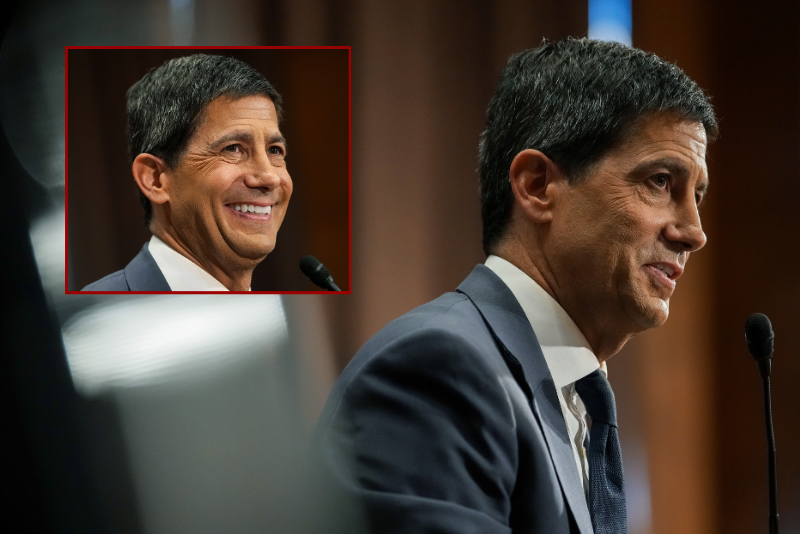
In a shift for the nation’s monetary policy, the U.S. Senate voted 54–45 on Wednesday to confirm Kevin Warsh as the 17th chair of the U.S. Federal Reserve.
The vote, which largely followed party lines, marks the end of Jerome Powell’s eight-year tenure at the helm of the central bank and installs a leader whom President Donald Trump has praised as a proponent of positive “regime change” within the institution.
Trending: PRESIDENT TRUMP: ““When I get out of office 8 or 9 years from now…”
Senator John Fetterman (D-Pa.) was the only Democrat to join a unified Republican caucus in supporting the nomination.
Warsh, 56, returns to the Federal Reserve after previously serving as its youngest-ever governor from 2006 to 2011. Since leaving the board, he has spent years as a fellow at Stanford University’s Hoover Institution and a partner at billionaire Stanley Druckenmiller’s investment office.
His confirmation follows a turbulent few months in Washington, D.C., during which his path to the chairmanship was briefly blocked by Senator Thom Tillis (R-N.C.).
Tillis had withheld his support until the Department of Justice (DOJ) dropped a criminal investigation into Powell regarding a multi-billion dollar renovation of the Fed’s headquarters — a probe that prosecutors ultimately abandoned in April, clearing the way for Wednesday’s floor vote.
The transition comes at a delicate moment for the American economy, which is currently grappling with the global fallout from the conflict in Iran. While President Trump has frequently criticized Powell as a “stubborn mule” for his reluctance to aggressively slash interest rates, Warsh walked a fine line during his testimony.
He has signaled an openness to lowering borrowing costs to spur growth while simultaneously vowing to maintain the Fed’s traditional independence. During his confirmation hearings, Warsh also pushed back against allegations from Democrat critics, including Senator Elizabeth Warren (D-Ma.), that he would act as a “sock puppet” for the Trump White House.
Despite his departure from the chair’s office this Friday, Powell is expected to remain on the Federal Reserve’s Board of Governors for an unspecified period, citing a desire to ensure institutional stability while the remnants of the DOJ probe are finalized.
For his part, Warsh must now focus on internal consensus-building. He inherits a deeply divided Federal Open Market Committee (FOMC) that saw its highest number of dissents in decades during its most recent meeting.
Before officially taking the oath of office, Warsh has also committed to divesting a personal fortune estimated at over $100 million, including large stakes in private ventures like SpaceX and Polymarket.
Once sworn in, his immediate challenge will be navigating the June policy meeting, where investors will be watching for any signal that the “Warsh era” will favor the rate cuts the White House desires or a return to the “hawkish, inflation-focused stance” he was known for during the 2008 financial crisis, analysts say.
With the Senate’s approval now secure, the financial world prepares for a transformative period in American central banking.
The Federal Reserve
The Federal Reserve occupies a unique position in the U.S. government, commonly described as “independent within the government.” It is not part of the executive branch in the traditional sense, nor is it a private entity. Established by Congress through the Federal Reserve Act of 1913, the Fed is a creature of statute. Its Board of Governors — including the Chair — is nominated by the president and confirmed by the Senate.
However, it does not receive funding through the congressional appropriations process. Instead, the Fed is self-financing: it generates revenue primarily from interest earned on its holdings of U.S. government securities and from fees for services it provides to banks and the financial system. After covering its operating expenses and paying statutory dividends to member banks, it remits any surplus earnings to the U.S. Treasury.
This financial autonomy is a deliberate design feature intended to shield monetary policy decisions from short-term political pressures associated with the annual federal budget process. By not having to request annual appropriations from Congress, the Fed can focus on its longer-term objectives without the leverage that funding control can exert.
A core rationale for this independence is to promote objective, data-driven monetary policy rather than partisan considerations. If the Federal Reserve operated like a typical executive department, such as the Department of the Treasury, an administration might face stronger incentives to pressure the central bank into lowering interest rates or expanding the money supply to stimulate a temporary economic boom before an election — potentially at the cost of financial instability later.
Stay informed! Receive breaking news alerts directly to your inbox for free. Subscribe here. https://www.oann.com/alerts
What do YOU think? Click here to jump to the comments!
Join the conversation!
Please share your thoughts about this article below. We value your opinions, and would love to see you add to the discussion!