

OAN Staff Lillian Mann and Brooke Mallory
3:44 PM – Monday, May 25, 2026
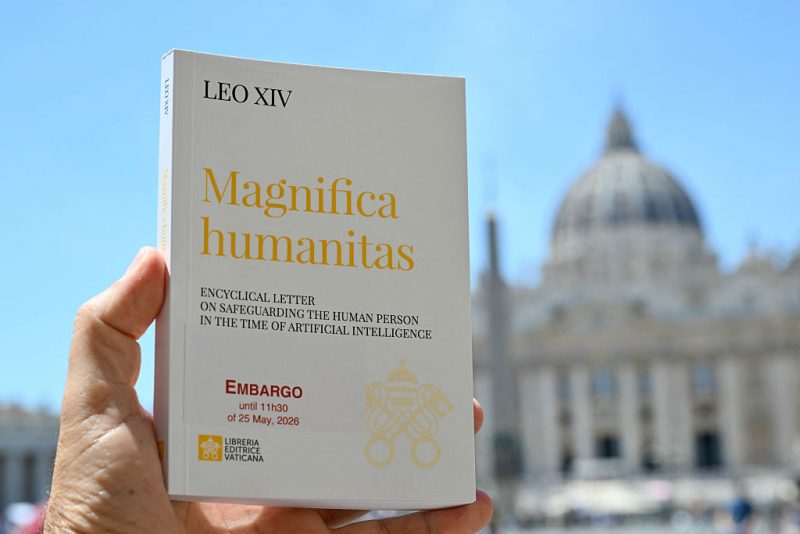
In the first major theological text of his papacy, Pope Leo XIV issued a encyclical titled “Magnifica Humanitas” (“Magnificent Humanity”), demanding the “disarmament” of artificial intelligence (AI) and offering a first-of-its-kind official papal apology for the Catholic Church’s past connections to slavery.
Presenting his manifesto to an audience at the Vatican on Monday, the U.S.-born pontiff explicitly linked the historical tragedy of slavery to the contemporary rise of AI, warning that a failure to ethically regulate modern technology will inevitably lead to new forms of human exploitation.
Addressing the rapid integration of these systems into society, he noted that “Artificial intelligence already touches many areas of our lives and affects decisions that shape human co-existence,” adding, “I feel entrusted to look upon another huge transformation with eyes of faith, with lucidity of reason, with openness to mystery and with cries of the poor and the earth resounding in my heart.”
Trending: Report: Tech Company Accidentally Spends $500 Million on Anthropic’s Claude AI in Single Month
The encyclical carries a deeply personal resonance for Pope Leo, who highlighted his own American family history as descendants of both enslaved people and slave owners. Through this lens, “Magnifica Humanitas” confronts the Vatican’s centuries-long failure to recognize the Church’s role in legitimizing the slave trade.
Expressing profound institutional remorse, the Pope wrote, “It is impossible not to feel deep sorrow when contemplating the immense suffering and humiliation endured by so many in stark contrast to their immeasurable dignity as persons infinitely loved by the Lord,” before stating clearly, “For this, in the name of the church, I sincerely ask for pardon.”
Beyond addressing historical injustices, the manifesto outlines urgent propositions to preserve the “grandeur of humanity” against the backdrop of rapid technological advancement and the expanding role of AI in warfare, a development he insists demands “the most rigorous ethical constraints.”
In a theological shift, Pope Leo XIV also declared that the traditional Christian “just war” theory — the centuries-old, four-part doctrine used to determine when military conflict is morally justified — is “now outdated,” arguing instead that military force should be restricted exclusively to “self-defense in the strictest sense.”
Condemning the normalization of global strife, he asserted that “The construction of a world in a state of perpetual conflict is an evil and must be named for what it is,” while telling the global Catholic community that “Humanity possesses far more effective and capable tools for promoting human life and resolving conflicts, such as dialogue, diplomacy and forgiveness.”
Ultimately, the Pope described the ethical regulation of AI as a critical test to prevent the repetition of past moral failures. He acknowledged that while human dignity has always been the theological foundation of Church doctrine, “even so, it took eighteen centuries for its full incompatibility with slavery to be explicitly recognized.”
Concluding that this historical delay “constitutes a wound in Christian memory, one from which we cannot consider ourselves detached,” Pope Leo stated that the Vatican must firmly condemn digital-age human trafficking and modern exploitation.
He further urged the Church and global leaders to act decisively now “if we want to avoid the need to ask for pardon again in the future for having failed to respect the treasure of human dignity that is required by our faith.”
Stay informed! Receive breaking news alerts directly to your inbox for free. Subscribe here. https://www.oann.com/alerts
What do YOU think? Click here to jump to the comments!
Join the conversation!
Please share your thoughts about this article below. We value your opinions, and would love to see you add to the discussion!