

OAN Staff Jenna Lee
9:28 AM – Wednesday, May 27, 2026
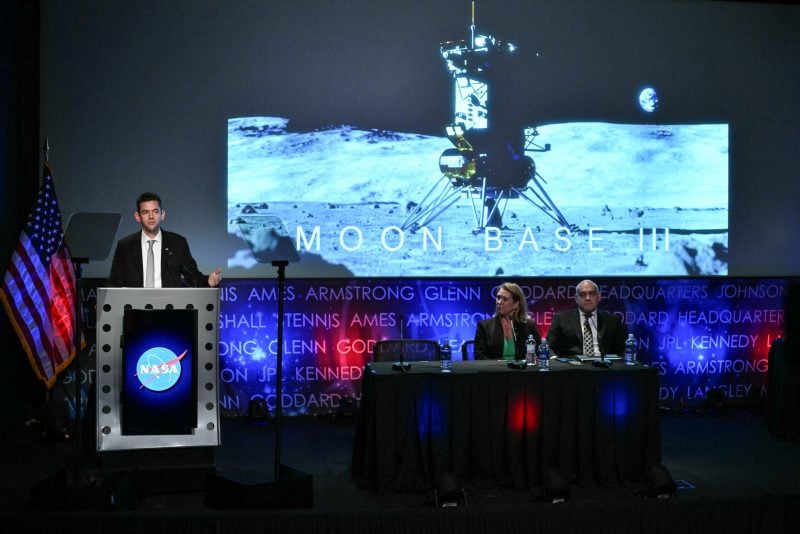
The National Aeronautics and Space Administration (NASA) has announced a major strategic shift outlining its plans to build a permanent human outpost on the moon by 2032.
The administration made the ambitious announcement on Tuesday, marking a historic push to establish a full-time human presence on the lunar surface.
Trending: BREAKING: Supreme Court Hands President Trump 9-0 Win
The development of the estimated $20 billion infrastructure will rely heavily on commercial space companies. NASA is utilizing both Elon Musk’s SpaceX and Jeff Bezos’s Blue Origin to execute the upcoming sequence of Artemis missions, fostering a competitive race to deliver cargo and crew landers to the lunar South Pole.
Reportedly, SpaceX has faced some setbacks and delays while building its contracted Starship Human Landing System.
The Moon’s South Pole would be ideal since its frozen water could be used for drinking water or for producing oxygen.
“The limiting step is getting the astronauts down onto the surface. It sounds to me like [NASA] feel they’re in a position where they have to start saying they’ve got plans. So I think there’s a lot of political drive behind this,” said Dr. Simeon Barber, a lunar scientist at Open University to BBC News.
The decision comes as NASA faces mounting pressure to lead the new space race against China. Just this week, China announced the launch of its Shenzhou-23 spacecraft, sending a fresh crew of astronauts to the Tiangong space station as Beijing aggressively pursues its own goal of landing humans on the moon by 2030.
“It would not surprise me at all if China gets there first,” said Dr. Barber.
NASA’s new blueprint will kick off with an accelerated schedule of early surface initiatives, including a Blue Origin cargo lander payload test targeted for late 2026, followed by two additional logistical missions scheduled before the end of next year.
“People are looking up again, believing in big things again, and paying attention as America returns to the moon again, and this time to stay,” said NASA administrator Jared Isaacman at a press conference in Washington, D.C.
“We are not jumping right into the glass dome moon base. We intend to take an iterative approach, sending a demand signal to industry for a lot of landers and rovers and tech demonstrations, and all the scientific payloads these missions can accommodate. We are leveraging the Nasa playbook from the 1960s, figuring out what works and what doesn’t in this epic science of survival, because the moon base is as beautiful as it is hostile,” he added.
Stay informed! Receive breaking news alerts directly to your inbox for free. Subscribe here. https://www.oann.com/alerts
What do YOU think? Click here to jump to the comments!
Join the conversation!
Please share your thoughts about this article below. We value your opinions, and would love to see you add to the discussion!