

OAN Staff Katherine Mosack
3:07 AM – Saturday, May 30, 2026
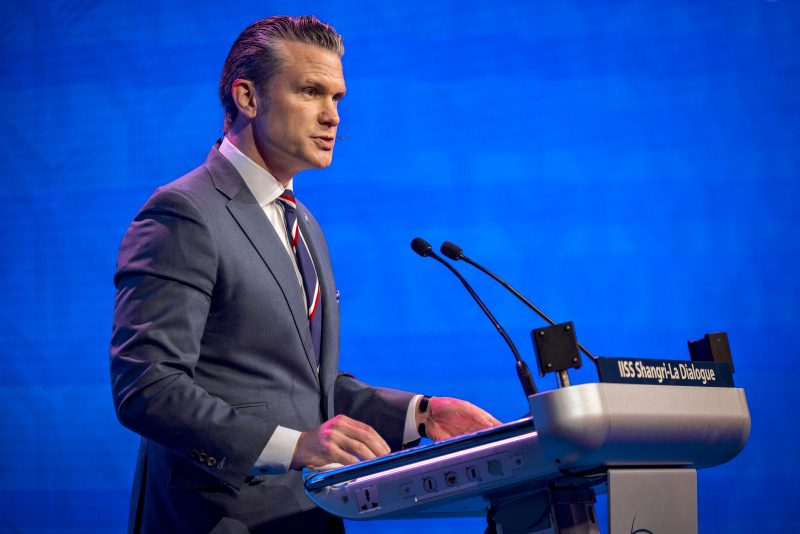
Secretary of War Pete Hegseth delivered a speech outlining a shift in U.S. Indo-Pacific strategy at the 2026 Shangri-La Dialogue.
Speaking on behalf of the Trump administration on Saturday, Hegseth noted that “those who long for peace must prepare for war,” referencing President Theodore Roosevelt’s famous proverb, “Speak softly and carry a big stick,” which the War Department has adopted under his leadership.
Trending: Report: Teen Brain Dead After Falling from Car During Celebration After San Antonio Spurs’ Win
The secretary declared that “the era of the United States subsidizing the defense of wealthy nations is over,” demanding that allied countries “step up” when it comes to their own national defense as the U.S. has, according to the U.S. National Defense Strategy.
“We need partners, not protectorates. We seek alliances built on shared responsibility, not dependency,” he stated.
He praised Asian nations for viewing geopolitics through a pragmatic lens, quipping that Western European nations might take note.
“Our partners in Asia have long understood that the bedrock of a durable partnership is not based on idealistic values, but on the concrete alignment of national interests,” he said, later adding, “When our interests align, we act together with focused resolve. When our interests diverge, we adjust pragmatically without the drama or the moralizing.
Hegseth called for a military posture that is “strong, quiet and clear.”
“We are ready to work with all of you where you are, based on your own situation, your own geography, and your own cultural, political, and economic realities to ensure that a Pacific free of any dominant hegemon is secured,” he said, noting that the Trump administration’s demand for burden sharing is not “a my way or the highway approach.”
He emphasized that his department’s primary objective is to maintain a favorable balance of power in the Pacific so that no single state — explicitly naming China — can establish hegemony or disrupt free commerce.
“When we look across the region today, there is rightful alarm regarding China’s historic military buildup and the expansion of its military activities in the region and beyond,” he explained.
One example of China flexing its military prowess lies in its buildup near Taiwan. During President Donald Trump’s state visit to China this month, Chinese President Xi warned that the island could cause “conflicts” if not “handled properly.”
For China’s part, Xi agreed to “build a constructive relationship of strategic stability based on fairness and reciprocity” with the U.S., according to Hegseth, who witnessed his talks with Trump.
“What the United States delivers is strength that is disciplined, resolve that is steady, and leadership that is confident enough to speak and walk softly while carrying a big stick,” Hegseth stated. “What we seek and what the President has constantly articulated is a genuinely stable equilibrium that works for Americans as well as our ally, a favorable but durable balance of power in which no state, including China, can impose its hegemony and hold the security or prosperity of our nation and our allies in question.”
Hegseth went on to call out several Asian countries that have been investing in their own defense systems in order to “contribute to our collective defense.” In South Korea, for example, President Lee Jae Myung increased defense spending to “the new global standard of 3.5%.”
“President Trump is setting the gold standard. We demand 3.5% from our allies and partners, and we are going well beyond that number. We expect every single ally and partner to match that kind of resolve,” Hegseth asserted.
He continued, “for those who believe they can continue to free ride on the generosity of the American taxpayer, hear us now. Those days are over. Allies who refuse to step up and carry their own weight for our collective defense will face a clear shift in how we do business. … It’s what we owe each other, and most importantly, what I owe the American people and my troops, the most precious asset we have.”
Stay informed! Receive breaking news alerts directly to your inbox for free. Subscribe here. https://www.oann.com/alerts
What do YOU think? Click here to jump to the comments!
Join the conversation!
Please share your thoughts about this article below. We value your opinions, and would love to see you add to the discussion!