

OAN Staff Katherine Mosack
9:13 AM – Saturday, May 23, 2026
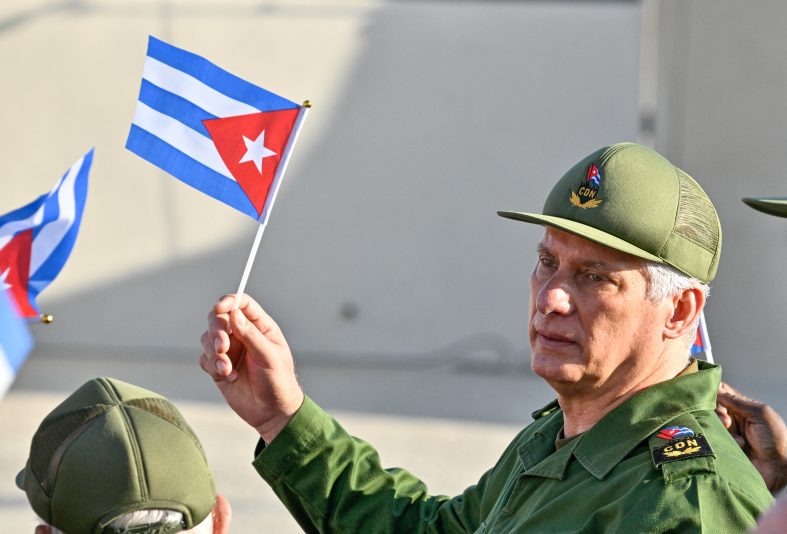
Cuban President Miguel Díaz-Canel warned of a “bloodbath” if the United States were to engage in military combat with Cuba after reports of the Communist regime amassing drones to possibly attack Florida.
On Monday, the Cuban president said that threats of “military aggression” against his country from “the world’s greatest power are well-known.”
“The threat itself already constitutes an international crime. If it were to materialize, it would trigger a bloodbath with incalculable consequences, plus the destructive impact on regional peace and stability,” he wrote. “Cuba poses no threat, nor does it have aggressive plans or intentions against any country. It has none against the U.S., nor has it ever had any.”
He continued, “Cuba, which already endures a multidimensional aggression from the U.S., does have the absolute and legitimate right to defend itself against a military onslaught. Yet that cannot be wielded, either logically or honestly, as an excuse for imposing war on the noble Cuban people.”
Díaz-Canel’s comments come after President Donald Trump’s administration tightened sanctions on the country, as well as entities that do business with it, putting economic pressure on the regime.
The United States government, along with organizations such as Human Rights Watch and the United Nations Human Rights Council, has accused the Cuban government of a range of human rights violations for decades. These include repression of political participation, restrictions on the press and free speech, limiting the freedom of assembly, poor prison conditions and limits on religious freedom.
Trump called Cuba a “failed country” last week, hinting that his administration would have talks with the Cuban leadership.
Days later, the director of the Central Intelligence Administration (CIA), John Ratcliffe, led a delegation of U.S. officials to Havana, where Cuban officials pleaded their case that their country does not pose a threat to U.S. national security.
The Department of State has an ongoing invitation for Cuba to receive a $100 million relief package for Cuban citizens to receive internet access, medical treatment and food. The aid would be distributed by independent groups, including the Catholic Church.
Former Cuban President Raúl Castro, 94, was also indicted by the U.S. government on murder charges this week.
Meanwhile, Cuba acquired more than 300 military drones and discussed using them to attack the U.S. Naval base at Guantanamo Bay, U.S. maritime vessels and stations in Key West, Florida, Axios reported, citing “classified intelligence.”
Key West is only 90 miles north of Havana, Cuba.
The report claimed Russia and Iran were supplying the drones.
The Kremlin issued a statement on Monday confirming that it remains in “constant contact with our Cuban friends.”
“When we think about those types of technologies being that close, and a range of bad actors from terror groups to drug cartels to Iranians to the Russians, it’s concerning,” a senior U.S. official told the outlet. “It’s a growing threat.”
On Friday, the Cuban president reiterated his stance that Cuba is peaceful, but has a right to defend itself.
“To the American people, to the decent politicians of that country, we reaffirm that Cuba neither threatens, nor challenges, nor provokes the U.S. or any other country in the world. Cuba is a nation of peace,” he stated on X. “We are protected by the right to legitimate defense established by international norms.”
Stay informed! Receive breaking news blasts directly to your inbox for free. Subscribe here. https://www.oann.com/alerts
What do YOU think? Click here to jump to the comments!
Join the conversation!
Please share your thoughts about this article below. We value your opinions, and would love to see you add to the discussion!