

OAN Staff Addie Davis
8:51 AM – Monday, May 25, 2026
Authorities confirmed that the threat of a boiling liquid expanding vapor explosion (BLEVE) for the failing chemical tank in Orange County, California, has been ruled out.
In a Monday morning update, Orange County Fire Authority (OCFA) Interim Fire Chief TJ McGovern and Incident Commander Chief Craig Covey confirmed that after an overnight mission to the tank, they could report that the BLEVE threat was eliminated.
“We are happy to report that the threat of a BLEVE is now off the table. That threat has been eliminated,” McGovern said.
Trending: AI Fail: Starbucks Abandons AI-Powered Inventory Tool After Only 9 Months
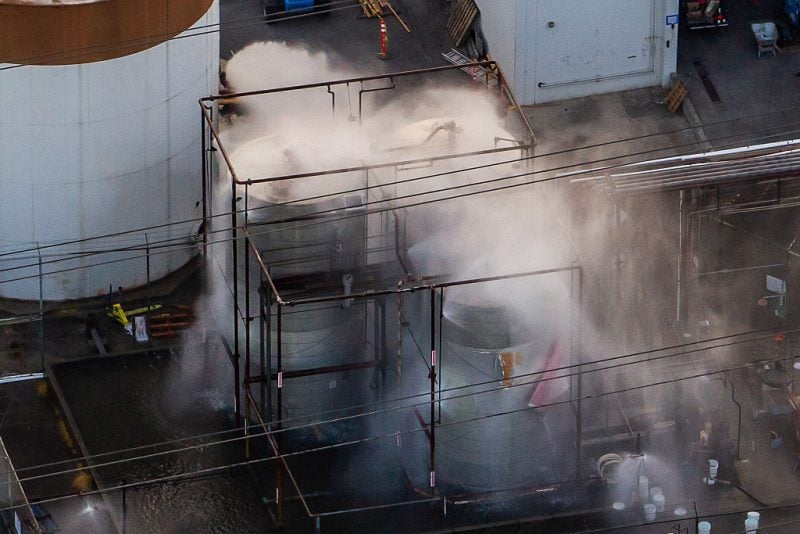
Previously, in a Sunday morning statement, McGovern had said a crack was found on the tank during a late night reconnaissance mission. During a subsequent Sunday update, the interim fire chief said an all-night mission would be conducted to confirm that the crack had released pressure and that the BLEVE threat, which he deemed the worst-case-scenario, was eliminated.
Since Thursday, the volatile and flammable chemical methyl methacrylate (MMA), used to produce components in the aerospace industry, has been overheating and venting from the 34,000-gallon tank, which is holding between 6,000 to 7,000 gallons of MMA, authorities explained. On Friday, evacuation orders were sent out, with media estimates stating that nearly 50,000 residents have had to leave the area.
Governor Gavin Newsom (D-Calif.) on Saturday declared a state of emergency for Orange County as fire personnel continued to address the situation.
According to the Orange County Sheriff’s Department, six cities have been affected by the evacuation orders: Garden Grove, Stanton, Anaheim, Cypress, Westminster and Buena Park.
Covey had initially said there were only two options for the failing tank, stating that it would either explode or leak and spill thousands of gallons of harmful chemicals.
In a Sunday interview with CNN’s “State of the Union,” Environmental Protection Agency (EPA) Administrator Lee Zeldin said they were being told the tank would fail, though the outcome was still unclear.
He noted that the most catastrophic scenario would be an explosion in which other tanks would also go up in flames. However, Zeldin said the most-likely event would be a low-volume release, “where the local authorities are going to be able to monitor, neutralize and contain the threat.”
Fire personnel were continuing to work on keeping the temperature of the tank down, noting it was key to keep it under 85 degrees, Zeldin said.
Covey said on Monday that the temperature was reducing and is currently now at 93 degrees, which is an improvement from the 100 degrees it had been at previously.
The EPA administrator had also clarified that the situation is currently an emergency response rather than an environmental response, the scale of which would be determined by the outcome of tank failure.
The owner of the plant site, GKN Aerospace, gave a Sunday statement, regarding the incident.
“We are acutely aware of the uncertainty this incident is causing and sincerely apologise for the ongoing disruption to the local community,” said a GKN spokesperson.
On Sunday, the OCFA reported that there was no active leak, which was confirmed through atmospheric monitoring.
Currently, no injuries in relation to the failing tank have been reported. McGovern emphasized that although the risk of a BLEVE has been eliminated, the evacuation orders remain in place.
Stay informed! Receive breaking news alerts directly to your inbox for free. Subscribe here. https://www.oann.com/alerts
What do YOU think? Click here to jump to the comments!
Join the conversation!
Please share your thoughts about this article below. We value your opinions, and would love to see you add to the discussion!