
OAN Staff Lillian Mann
6:30 PM – Monday, May 4, 2026
On Monday, Australia launched public hearings into the December Bondi Beach mass shooting, as Jewish Australians voiced growing concern over a sharp rise in antisemitism. The attack occurred on December 14, 2025, during a Hanukkah festival at Bondi Beach, when two gunmen opened fire, killing 15 people and hospitalizing 40.
The two-week sitting will examine the nature and prevalence of antisemitism in Australian’s institutions and society, following calls to action against Jewish hate amid a surge in antisemitic threats, crimes, and attacks over the past year.
Trending: Trump-supporting Miss North Carolina USA STRIPPED of title over problematic posts
Virginia Bell, a retired judge and head of the federal royal commission, said the first block of public hearings will examine the nature and prevalence of antisemitism.
A second block of hearings, scheduled for later in May, will focus on the circumstances leading up to the Bondi Beach attack, as well as issues raised in the interim report.
“The sharp spike in antisemitism that we’ve witnessed in Australia has been mirrored in other Western countries and seems clearly linked to events in the Middle East,” said Bell at the hearing opening. “It’s important that people understand how quickly those events can prompt ugly displays of hostility toward Jewish Australians simply because they’re Jews.”
Australian Jews also voiced concerns on Monday over a surge in antisemitic attacks following Hamas’ October 7, 2023, attack on Israel, in which the terrorist group killed about 1,200 people and took 251 hostages. In the year that followed, the Executive Council of Australian Jewry recorded more than 2,000 incidents, compared with fewer than 500 the previous year.
The Jewish Australians who were called to give evidence on Monday recounted their experiences of hatred, some using pseudonyms to protect their identities for safety concerns.
A “summer of terror” followed the Bondi Beach shooting, as a string of arson and graffiti attacks against synagogues and Jewish businesses in Sydney and Melbourne, the inquiry was told.
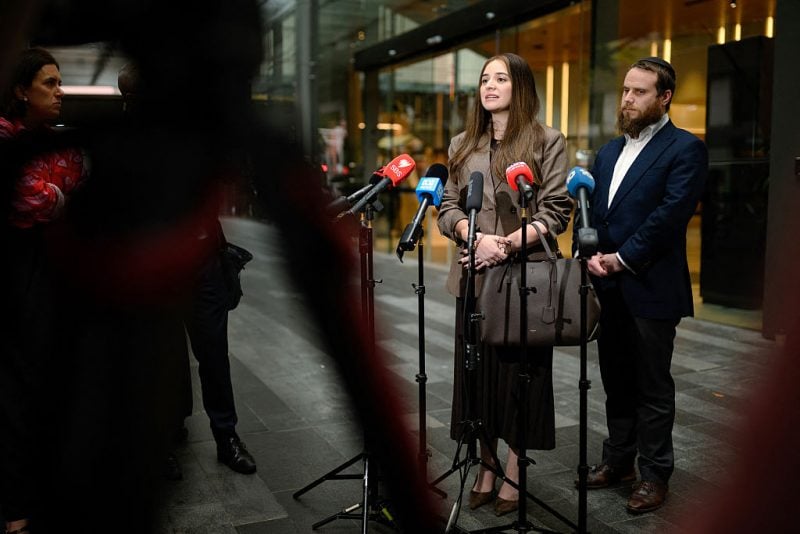
Sheina Gutnick, who lost her father, Reuven Morrison, in the Bondi attack, said antisemitism had damaged her family’s sense of safety and freedom of movement. Morrison, 62, had thrown a brick at one of the gunman before he was fatally shot.
Gutnick’s refugee parents had met at Bondi Beach, so the beach had previously been a scene of many happy childhood memories for her.
“Now Bondi holds a really, really heavy weight in our community’s heart,” Gutnick said.
She added that a year earlier she had been verbally abused while carrying her baby in a Sydney shopping mall after a man noticed her Star of David necklace.
“I felt shocked, exposed and unsafe,” said Gutnick. “There were many people around me but no one intervened.”
“As a mother, I’m constantly weighing up the risk of exposing my children to environments where they may be witness, or subject, to antisemitism,” she told the panel.
“I felt as though antisemitism was allowed to come into the open,” she added. “All of a sudden it was socially, morally acceptable for antisemitic comments to be made in public discourse,” Gutnick said.
Holocaust survivor Peter Halasz, an 86-year-old Holocaust survivor who fled to Australia from Hungary who spoke at the hearing said he had been afraid to wear his Star of David in public since Jews “have become targets” in Australia.
“What is happening in Australia today is not a faint echo of a distant past,” Halasz emphasized. “For those of us who lived through the 1930s and 1940s, it is something we recognize, and that recognition is frightening and cause for alarm.”
Halasz shared with the commission that his mother was shot by Nazis in 1944, and he had only survived “because of the extraordinary courage,” of those around him as a little boy.
“I lived through what hatred can do to people … what is happening in Australia today is not a faint echo of a distant past [but] something recognized … and cause for alarm,” he told the commission, Halasz said.
Furthermore, other members from the Jewish community have expressed their concern regarding Jewish schools.
Stefanie Schwartz, the president of Sydney Jewish primary school Mount Sinai College, shared her experiences of practicing drills with young students to prepare for terrorist attacks, along with “extreme” security presence on campus.
“You walk past our school and it looks a lot more like a prison than a primary school,” Schwartz noted.
Furthermore, because of Australia’s small Jewish population, the shock has been especially impactful, as members had not experienced such a high volume of threats before, witnesses said on Monday.
“Now everyone is scared all the time,” said Toby Raphael, vice president of Sydney’s Newtown Synagogue, which was daubed with swastikas during a wave of antisemitic crimes in the city in 2025.
Australia’s federal and state governments are now considering tightening already strict gun control measures after a Royal Commission report urged leaders to prioritize nationally consistent firearms laws and a weapons buyback program.
Naveed Akram, one of the shooters, was wounded but survived. He has been charged with committing a terrorist act, 15 counts of murder, and 40 counts of attempted murder, and has not yet entered any pleas.
His father, Sajid Akram, the other gunman, was a licensed shooter, he legally owned the firearms used in the attack. He was fatally shot by police at the scene.
The commission is due to deliver its final report on December 14th, exactly a year after the attack.
Stay informed! Receive breaking news alerts directly to your inbox for free. Subscribe here. https://www.oann.com/alerts
What do YOU think? Click here to jump to the comments!
Join the conversation!
Please share your thoughts about this article below. We value your opinions, and would love to see you add to the discussion!